Monday, March 22, 2010

Business Process Modeling


Modeling is a very important aspect of business. Business Process Modeling is usually performed by managers and analysts, who are seeking ways to improve the business and promote efficiency in the company. This is generally done using computer software, but is not required to do so. Managers then use these models to attempt to incorporate change into their organizations. Although most models alone can not provide adequate information to improve the company by themselves, technology is advancing to the point where computer simulations may enable businesses to predict different outcomes that changes will bring, with increased accuracy.
The history of Business Process Modeling dates back to the early 1900's with the development of the Gantt Chart, which is basically a bar chart that shows a projects schedule. It was developed by Henry Gantt, and is still widely used today, as the invention of computers has given it new capabilities. however there are numerous business process models that are currently used. Some of them include flow charts, block diagrams, PERT diagrams, IDEF, and control flow diagrams. These are all valuable tools that companies use in order to enhance their operations. A fun fact is that all of these models were developed before the term business process model, which was popularized by a man named S. Williams in 1967.
Business process modeling is made up of many different components. It generally uses the business's overall business model, then integrates specific processes into it, in order to illustrate what steps are taken during the process. After this analysts and managers generally research the model, attempting to find areas for improvement and then predicting different outcomes that changes will bring to the process. There are many different tools and languages that can be involved in a business process model, which is more of a topic for another blog. There are also many related processes that business process models enhance; these include business reference models, business process integration, business process re-engineering, and business process management.

Friday, March 19, 2010

Anna's 7th post

If I have learned only one thing this semester, it would be to protect my privacy. Between learning about denial of service attacks, viruses, worms, adware and spyware I have officially been scared. In class we have learned many ways to insure a safe identity.

One thing we've learned is to never write down your passwords. This seems so obvious but I didn't realize how important it was until it was emphasized in class and websites. I have a horrible memory and I always write my passwords down because if I don't I never remember and have to reset it or getting it sent to my e-mail, which is just a hassle. I've realized the hassle is worth it instead of getting my credit card information, bank statements or e-mail hacked. We also learned what constitutes a safe password, such as making it at least 6 characters, using upper and lowercase and both numbers and letters.

I once saw a TV show where a wife spied on her husband by tracing his keystrokes to track his e-mails. I thought this was so unrealistic until we learned in class that there actually is spyware to trace that. Then, when I was filling out my FAFSA information, I saw a real life application. Instead of typing in my social security number, the website offered a keyboard on the screen that allowed the mouse to click on the numbers so keystrokes couldn't be traced.

Telecommuting


Have you ever wanted to work from home? I know that I have! As technology integrates itself more and more into our lives, the possibilities for changing the way that work is done seems endless. One way that change will (hopefully!) happen, is by increasing the amount of workers who telecommute.

There are, as with pretty much everything, some pros and cons to telecommuting. Some of the pros include:
  • Saving money - having workers do their tasks at home means that firms can cut down on the size of the offices that they would need to maintain a workforce. It may even mean that they will not have to have a mortgage or lease agreement at all - depending on the industry.
  • Work can be done from anywhere. If worker man Bob remembers something at midnight, he doesn't have to wait until the next day to make the change or addition.
  • Environmentally friendly - fewer or smaller office buildings would mean less pollution and less land taken away from wildlife.
  • Of course, there is also the personal happiness and well-being that office workers would feel from working in an environment that they feel comfortable in (Personally, flourescent lighting always depresses me, and leaves me feeling drained)
Where there are pros, however, there are usually cons that come and rain on the parade:
  • Distractions - will your kids, pets, significant others, the TV, friends, or whatever be distracting you from your duties?
  • Do you have the space at home to set up a virtual office with all of the equipment that may be needed? Is this space used by others who may result in the afermentioned distractions?
  • Are you the type of person who can manage yourself? Will you be able to handle working from home, or will you be too tempted to just go watch TV or something instead?
  • Do you work with sensitive information that people may not want to have left out for any one to see?
  • If you have a problem with your computer system, or an office machine - you will not have the option of calling IT to come and fix the problem.
There are probably many other pros and cons that I could mention. I'm still hoping that some day I will be able to get paid to work in my pajamas from home! For a list of some companies that are telecommute friendly, visit 2 work-at-home.com

Web 2.0


Roughly 5 years after the onset of Web 2.0 development and technology, pretty much any moderately successful website is incorporating it. Being a heavy Google products user, my life is filled with web 2.0.

Gmail was probably the first example of a web 2.0 page that I began using regularly. As discussed in class, the aspect of the gmail interface that makes it 2.0 are the server side rendering that don't require a complete refresh of the page. Occasionally I'll stumble upon a website (or more frequently, a blog) that doesn't incorporate this kind of server-side rendering, and it is incredibly annoying. We've come along way since the low baud-rate dial-ups of the early to mid 90's, and now, we've become completely impatient with sites that don't adopt the latest (and quickest) technologies.

The other Google products I regularly use are iGoogle, Google Reader, Google Talk (IM client), and Google Voice. All of these products are web apps, which means that you don't download or install software directly on to your computer. To have a rich user experience while maintaining this cloud-located software, web 2.0 is integral. It allows Google to create web apps that behave like computer-based software. Its also brilliant insofar as Google doesn't have to send out updates when it patches pieces of the software, it allows people on a wide range of internet devices to utilize the same experience (including low-powered phones), it makes collaboration a lot easier, it rids people of a need for increasing memory capacities, its automatically backed up, you can access your information anywhere you go and on any device that has an internet connection. I'm sure there are even more benefits, but as you can see, Web 2.0 is the step that allowed cloud computing to really begin to take off. I'm not sure what Web 3.0 will bring, but I will assume it will further push our computing into the cloud while further enriching the experience of interacting with our software (or webware).

bad inventions


I have seen a lot of people blog about really cool new inventions and that got me thinking about what some of the worst inventions are. Lets face it not all ideas are good ones and not every invention should have been made. Through out time many of these bad ideas slipped through the cracks and actually made it to production. In 1953 the U.S. government came out with a M3 sub machine gun with a curved barrel that allowed you to shoot around corners. I guess this was for those who didn't want to see who they were shooting at. In 1963 John H T Rinfret invented a security feature for his briefcase. When someone tires to take the briefcase a chain connected to your arm releases the contents to spill out the bottom. Whats the point if its already chained to your arm. These are just a few of the bad inventions I was able to find.


One of my favorite is the portable sauna. This idea came from Finland in 1962 and surprisingly they continue to make these. The market for house hold compact saunas has apparently grown in the past decade. In 1937 above the streets of London there were cages that hung off the window. The cages were given out by the Chelsea Baby Club as an extra place for you to put your baby. As long as you didn't have a window garden or no problem hanging your baby out a 5 story window this is a great way to store your child. 1959 aches and pains were sometimes treated with a dose of honegar. This is a mix of honey and vinegar that Dr. DeForest C. Jarvis came up with in order to help subdue pain. It seems like the list of bad ideas is twice as long as the list of good ones.


The ability to fly has obviously changed the world, but not all aviation innovations have had the best success. In 1955 Leo Valentin introduced his bird man suit that he designed as a one man flying easy to use flying suit(seen above). Unfortunately on his first test from he dumped out of an airplane and was killed. Looking for something a little safer? In 1963 Hugo Gernsback invented the T.V glasses, but this made it hard to see anything else. In 1963 the Japanese came up with a device that meows and flashes lights up to ten times a minute. This was used in house holds to scare away mice. I think that a cat would do the trick even better and would be a lot less annoying. So next time you find your self victim of a bad idea just remember that your not alone. People have been coming up with bad ideas for a long time.

Thursday, March 18, 2010

Facebook


Mark Elliot Zuckerberg is the man who is best known for making the social network of what we call Facebook. Although facebook’s primary use is for people to reconnect with lost friends and family; that is not what it is only good for. Facebook can be used as an effective business tool. It is great for marketing, connecting with customers, advertisment and social media. You can also connect with huge bodies of people in any organization or workplace.

With more than 150 million members and counting, imagine what businesses could benefit from using this site. With these numbers rising on the loose, advertisment will be off the charts with posts by people who are interested along with icons that show up on everyone’s home page. People constantly are looking for job openings, assistance, technical support/help and ways of contacting the dealers who can give them what they’re looking for.

More and more businesses are jumping into the social media as marketing continues to show that online tools such as Twitter and Facebook can be an effective as well as a free way to reach everyone who may be interested. Along with some examples that were used in todays lecture.

According to a recent study by Aberdeen Group, top companies who are using social-networking sites like Facebook to improve interaction with customers, reveals that companies that are using these networks are 17 times more likely to improve customer satisfaction than companies that don’t use these sites. Using the site to spread the word about your business can pay off. What do you have to lose?

http://www.whitepapersource.com/marketing/facebook-for-business/

http://www.whitepapersource.com/marketing/facebook-for-business/

http://www.whitepapersource.com/marketing/facebook-for-business/

Web 2.0


So, today we talked about web 2.0. I never knew that there was two different versions of the web. Ever since 2004 we've had 2.0, and it couldn't be more amazing. I will begin with a quote from Terry Flew, the associate professor of media and communication in the creative industries faculty at Queensland University of Technology in Australia. "move from personal websites to blogs and blog site aggregation, from publishing to participation, from web content as the outcome of large up-front investment to an ongoing and interactive process, and from content management systems to links based on tagging (folksonomy)". He believed that these were the things that spawned the dawn of web 2.0.


Networking is bigger than ever now. With the enhancements of 2.0 we now have things like Facebook. It has 400 million active users as of today. We are able to not only communicate with people around the world without even leaving our homes, but we are also able to share files, such as pictures, videos, music, or basically anything you want. A very useful tool in the right hands. Google maps is another great example. As you are browsing a map, it requires a lot of information. When you zoom in and out on the map, the loading of the pictures is instantaneous.

Web 2.0 is not a different version of the internet, per say, more of a change in the way that users and developers use the web. For example, when you go to a site that uses the network effect, such as digg, you are not only able to gather up information, but build your own web page and utilize things such as comments, running software applications entirely through a browser, and, again, sharing files with each other. The user has much more control over their data, and their data is their data. Almost none of this was possible with web 1.0.


The network effect blew my mind. The math that is behind web 2.0 is amazing. I believe we have made our networking and business sites very useful because we have a lot of users out there today. The only way it could be utilized to the max is when every single person in the world is using the service, but that will never happen.

I'm excited to see what the next big thing will be in networking and the world of web 2.0. Can it get any better than this?

Photo courtesy of evohosting.

JAMS


JAMS (judicial affairs management system) is a comprehensive Judicial Affairs management solution for staff, students, and judicial affairs offices. It is the first product of its kind that integrates with the university's registrar, authentication. The system puts student data back in the control of the university and streamlines all administrative functions enabling the Departments to provide exceptional customer service. JAMS is 100% customizable, and user friendly, everyone can learn how to use it.

This software has many features that helps the university because more efficient in providing and storing data very fast. some of the features are:

Announcement Management System
Enterprise Calendaring
Online Applications
Sophisticated Incident Administration
Built-in processing
Document Management Capabilities
Hall/Room Assignment
Management Systems for RAs, RHCs, Area Coordinators
Automated Daily/Weekly Activity Reports
Email Management

and many more programs.

I'm a resident Advisor at Eastern Michigan, and as an RA we use this program for judicial purposes, and part of our jobs is typing in JAMS any incident we incounter so the judicial system can know and make the decision.
Many universities have started using this program, because it's just so easy to use and well programmed. there is hardly any problems we have encoutered using this software.

Human Computer Interaction


This is an image of a robotic arm attaching itself to a human brain. This is a dramatic yet realistic example of what we as human are working towards in terms of technological advancement. Human computer interaction is what I am getting at. Rosie from the Jetsons, Arnold from the Terminator, and Sonny from I Robot all seem a little far-fetched but the fact remains that it is the kind of interaction that we one day hope to have with machines and computers.

Technology has no limits. Computers, machines, and technological methodology can always be improved one way or another. Even as I type we are creating new ways for humans to interact with the computers and technological resources around them. A couple of week ago in class the professor showed us the example of the robot made by Toyota that could play the violin. Now what is to stop Toyota from making that same robot be able to use a computer, make a pot of coffee, or check me out of the grocery store line...oh wait we've already created that. as important as technology has become to our society we cannot let it get in the way of how we live our lives.

Technology is becoming so advanced and easy, that people are suffering because of it. I know that I still have to teach my mom how to use the internet or microsoft word, yet I know she is a smart and successful woman. I feel that we will one day overstep our boundaries in terms of developing computers and technology. Human computer interaction will become human-robot interaction and soon enough it will become robot-human interaction. What I am getting at is control. Human computer interaction is great as long as we are in control, yet many times we are at the mercy of the technological devices we use every day. I mean what happened to the classic pen and paper. I had an employee miss work the other day because he couldnt check his schedule because his computer broke down!! I print out the schedule and put one in my employees mailboxes every week at the office!! No excuse.

That robotic arm is on top of the human brain for a reason...it wont be human-computer interaction much longer.

Power Outages

Although last weeks discussion dealt with integration, the power outage at the College of Business and part of downtown Ypsilanti inspired me to write this blog instead on how dependent we are on technology and electricity. Just that little power outage forced some Ypsilanti stores to close for the day (as they couldn’t use their appliances), it made driving through intersections difficult (the traffic lights weren’t working), the COB parking structure a mess (the beam was stuck), students couldn’t use their laptops in class if they weren’t charged (the electrical outlets didn’t work), and our lesson probably would have been cut short if one of our classmates hadn’t had the PowerPoint presentation saved to his hard drive (the classroom computer didn’t work). I couldn’t help but sit and wonder what would happen if the entire city had lost power, or the state, or the country, or the world.

Electricity and technology rules most of our lives. We store our food in refrigerators, communicate via phones and email, are regulated by traffic lights, and manage our work lives on computers, just to name a few. We could eventually get around using electricity and the technology that uses it, but it would slow the pace of our lives down so much, that I believe it would wreak utter havoc on our society (that is too say if we had a power outage for let’s say a month).

One famous example of a “blackout” spreading pandemonium in society was the New York City Blackout of 1977. This was a case of nature versus technology, as several lightning strikes forced faulty circuit breakers to trip and not be able to allow electricity to flow through again. This absence of electricity caused mass rioting, looting, and arson. Another example of power loss is one that we should all be familiar with, the Northeast Blackout of 2003 that affected 55 million people in our region. The cause of this blackout was once again traces back to nature,

In February 2004, the U.S.-Canada Power System Outage Task Force released their final report, placing the main cause of the blackout on FirstEnergy Corporation's failure to trim trees in part of its Ohio service area. The report states that a generating plant in Eastlake, Ohio (a suburb of Cleveland) went offline amid high electrical demand, putting a strain on high-voltage power lines (located in a distant rural setting) which later went out of service when they came in contact with "overgrown trees". The cascading effect that resulted ultimately forced the shutdown of more than 100 power plants.

This blackout affected power generators, water supply, transportation, communication, and also led to some looting. It is clear to me, that electricity and technology really does play a large roll in our lives.

Software Integration


When embarking on a change, a developer takes a copy of the current code base on which to work. As other developers submit changed code to the code repository, this copy gradually ceases to reflect the repository code. When developers submit code to the repository they must first update their code to reflect the changes in the repository since they took their copy. The more changes the repository contains, the more work developers must do before submitting their own changes.

Eventually, the repository may become so different from the developers' baselines that they enter what is sometimes called "integration hell", where the time it takes to integrate exceeds the time it took to make their original changes. In a worst-case scenario, developers may have to discard their changes and completely re-do the work.

Continuous integration involves integrating early and often, so as to avoid the pitfalls of "integration hell". The practice aims to reduce timely rework and thus reduce cost and time.

Maintaining code repository means the practice advocates the use of a revision control system for the project's source code. All artifacts required to build the project should be placed in the repository. In this practice and in the revision control community, the convention is that the system should be buildable from a fresh checkout and not require additional dependencies. Extreme Programming advocate Martin Fowler also mentions that where branching is supported by tools, its use should be minimized. Instead, it is preferred that changes are integrated rather than creating multiple versions of the software that are maintained simultaneously. The mainline (or trunk) should be the place for the working version of the software.

Wednesday, March 17, 2010

Interaction

A few weeks ago in class we were talking about interaction and why it is used in business. we found out that it is important in the business worls because it helps us better understand the business as a whole. There are three kinds of interactions, we have computer-computer, human-human, and human-computer. Out of the three kinds of interaction we discussed, human-computer is my favorite and the most ineresting.

There is so much we can do with this type of interaction. Many of us use facebook, twitter, and other social networking sites everyday. If we really want to get technical, all we do is sit around and pass messages to one another through a computer. It's kind of lazy, but to us, it is entertaining- or at least it makes the time go by. Older adults will say we are wasting our time but I don't see how.

By sitting down at a computer, we can do our homework, chat with our friends, check emails, pay bills and even do some online shopping. All of this will take no less than 2-3 hours depending on what we have to do. On the other hand, if we weren't using the computer and we had to do every last one of the previously listed activities, it will take us alot longer because we have to get our cars and drive all over the place.

Human computer interaction is getting more and more advanced as the years go by. I hope I'm around long enough to see my kids have college courses in a room filled with nothing but chairs, tables, and one large computer. Sorry professors, this may mean a cutback in your profession.


Why use integration?


What is integration? It is the process where smaller pieces of software are brought together to form a larger piece of software for a specific purpose. Basically meaning that a smaller more efficient software can replace another just for a specific purpose. There are advantages to this process. Things such as a faster design and the development. Also it gives you a better performance with less redundancy. They also have used this process for many successful businesses because of their web services.


The EAI combines the function of the businesses together with each other. It reduces the cost and benefits in amount of productivity. But there are some dangers to this as well. Some of those could be that the software does not live up to their means. Saying that the product/service sometimes doesnt do what it is programmed to do. It also has malfunctions that cost money to fix or update.


The purpose of this is to ensure in multiple systems and to keep them constant. The vendor experience extracts the business policies or rules from the applications and transporting them into the EAI system. So if one of the applications are replaced with a different vendors app. the business rules do not have to be re- implemented. An EAI system can front-end a cluster of applications to provide a single consistent access interface to these applications and to shield users from having to learn how to interact with the different software packages.

Data Modeling


In class, I knew the concept of modeling and the great benefits it brings in some fields. Data model is characteristic abstract data. It helps to build clear relationship. Conceptual data model is one form of the modeling, especially E-R data model, which is one of the common conceptual data modeling. It is interesting for me to consider their internal relationships.

The basic shape is to describe the entities in rectangular frames. The attributes are described by ellipse. The relationships of different entities are showed by rhombic frame and appropriate named by underlying meaning. Use the lines to connect the rectangular frames and rhombic frame. If a person wants to know the multiple relationships between the two different entities, he should first confirm the attributes between two entities, and then define the types of relationships, finally combine attributes with the entities and the relationships .For example, a department consists of many students and a student can choose different courses, and the same courses can be chosen by different students. Therefore, the two above relationships are one-to –many and many-to –many. To express the three objects or more, the key is to build two relationships among the three objects.

The divide between entities and relationships is that when the behavior is happened among these entities, it is necessary to build relationship set or connect all the attributes of entities.

technology


I didn't what to blog about this week so I decided to Google technology, and this is what I found:


I found out that Microsoft is coming out with a cellphone. The article made it sound like that this wasn't the first phone they put out, but they were worried about the selling numbers due to the competition of the iPhone and T-Mobile Android. The phone slated to be called WinPho7. The phone is said to be a step down from the previous version WinMo 6.5. This was done to make it more user friendly, by not having it loaded with functions and the 6.5 version operating system was not have a friendly user interface. The new phone will be lacking a few key features that have been on previous models and you won't be able to do as much multi-tasking as on older models. Features like Cut & paste, full multitasking, and memory card support was eliminated from this unit. The multitasking was eliminated to help extend battery life and prevent complexities in the user interface. Cut and paste was also sacrificed on this phone. When asked iPhone owners how much they used cut and paste, some said once every 4 months. Another drawback with this phone is that all apps must be installed from the Windows Phone marketplace, not like the other phones where you could download directly from the internet.


Micorsoft has the phone hitting the market early September, and iPhone will update its phone in June. Once again Microsoft is putting themselves behind the eight ball and following in the footsteps of iPhone.


So Mircosoft decided that cut & paste, full multitasking, and memory card support was something this new phone could do with out. In there opinion, less is more. Better for the customer to a more user friendly phone and with a battery that will last longer. At this time I couldn't find a price for the phone, but I did manage to find out that HTC will be the manufacturer of the phone.

NASA stays competitive

I was trying to find something to blog about when a friend of mine suggested that i google NASA's Puffin project. I did, and couldnt believe my eyes! NASA has developed a special air craft called Puffin. "It takes off like a helicopter and flies like a plane. It can cruise at 140 mph and, with a boost mode, hit about twice that. Oh - and its electric," reports Jason Paur in a blog, which can be found at:http://www.wired.com/autopia/2010/01/nasa-puffin/

If you go to Nasa's website, http://www.nasa.gov/, you can navigate through their search to find the Puffin project. The puffin project was conceptualized by aerospace engineer Mark Moore. "Moore came up with the design for the electric powered 12 foot long, 14.5 foot wingspan, personal air vehicle as part of the coursework for his doctoral degree."

(Nasa.gov/topics/technology/features/puffin.html)

My first thought was that it was very Iron Man like! lol I am astonished that we have come this far with interfaces, and robotics together. And with the two different flight capabilites combined in one aircraft! That kind of integration is impressive. I wonder if we'll ever have the technology to drop the price on those so that we can use them in all of our armed forces?

Eventhough the Puffin hasnt been constructed yet, "NIA hopes to fly a remote control one tird sized model to validate assumptions made in academic studies, with the specific intent of exploring the transition from hover to forward flight."(NASA.gov)


Ubiquitous Computing

I know everyone and their brother has already posted on this subject, but it is very intriguing, so I think it merits another look. It is really exciting to be a part of a time when something like a "smart house" that would only have been a dream 7 or 8 years ago are becoming more and more possible. It would make hosting a party or social event so much easier, for one thing. To have everything change to the tastes of your guests would ease a lot of the burden on the host. No more would one have to ask what channel to watch. A microchip would just take care of it.

Another facet of this concept that intrigues me is that of a cellphone switching to Wi-Fi compatability where there is no cell signal. This would be extremely beneficial to me, in particular. My room at my parents is/was (I've since moved out) in the basement, and there was absolutely no service to be had. However, I had a very strong Wi-Fi signal on my computer. Not having to run upstairs everytime I got a call would be very appealing to me, albeit a little lazy.

All in all, while it is possible to have these smart houses, it is all but impossible for anyone who is not vastly wealthy. We see these being invented, but I think it will be a very long time before we see them as commonplace. Perhaps some restaurants, bars, or stores may start incorporating them before we see them in residences. Any way you slice it, I'm excited to see what the future will bring.

SMART Boards

About a month ago, my sister-in-law was talking about technology she uses in her classroom (she is in English teacher), but I had no idea what she was talking about. I have been out of high school for quite some time now, and I also came from a small school where we could not afford the newest technology anyway. I thought this would be a perfect opportunity to learn more about what she is using in her classroom because it shows how integrated technology is becoming with everyday life. When I went to school, we really only had chalkboards and chalk. I remember how exciting it was when we got our first whiteboard and could use dry-erase markers. When we wanted to display something for the rest of the class to see, we would have to go to the office and get our paper copied onto a clear sheet so we could display it through an overhead projector. Learning about how students use the board now shows me how quickly technology is growing and makes me wonder what things are going to be like in the future.


So what is this technology I am talking about? It is called the SMART Board. It takes the old white board that I fondly remember as a young student and integrates it with technology. It uses a projector that does more than just displaying an image on a screen, one sheet at a time, like the old overhead projector that I remember. Instead, it acts as a large touchscreen. It displays a computer’s video output on the whiteboard, and it is actually "the first interactive whiteboard to provide touch control of computer applications and annotation over standard Microsoft Windows applications." (1) To get a better understanding of what I am talking about, check out this video at http://www.youtube.com/watch?v=0U05WeXPGlk. SMART Boards were first introduced in 1991, but due to to the cost, we haven't seen them in the classrooms until more recently.


The picture below shows how the SMART Board can enhance classroom education. The teacher is able to display an image and then write on the image without destroying it. She is writing with
digital pens, which replaces the traditional whiteboard markers. These pens use digital ink and operate by "using an active digitizer that controls the PC input for writing capabilities such as drawing or handwriting." (1) Also, SMART Boards allow for a more interactive environment for the students through interactive text, images, sounds, and video files. It is easy to use, so students of all ages will have no problems participating. It has also been shown to decrease teacher stress, probably because teachers are able to do everything through one means of technology rather than multiple devices (such as a board, television to play video, and a projector to display images).


Why use the SMART Board instead of other means of interactive technology? For one, it is better for differentiated learning. SMART Boards are good in the classroom setting as well as corporate settings because of its ability to be shared with a large group. A tablet computer uses a touch screen as well, but it acts as more of a personal computing device and does not have a large projected screen.


Is the SMART Board compatible with most computers? Yes. This is a good device for all teachers because it is compatible with most computers. Versions are available for Windows, Mac, Linux, Solaris, and SGI (IRIX) operating systems.


The SMART Board has changed the way that learning has taken place in the classroom in just a short period of time. In the next ten years, I wonder how much more technology is going to change the classroom learning experience?


Sources:
(1) http://en.wikipedia.org/wiki/SMART_Board_interactive_whiteboard
Picture: http://warriortechs.files.wordpress.com/2007/09/mrs_lrosa_smartboard.JPG

Monday, March 15, 2010

RFID and Human Uses


RFID technology has enormous value in the many uses available to us in the future. I believe that one of the biggest concerns about RFID is how intrusive we will allow it to go. The retail sales industry could actually save money with RFID technology by the reduction of employee theft and shoplifting. WalMart has said it will not do business with anybody who sells to them that does not use this technology.


We are already using this technology in our pets, tracking shipments, and the retail and airplane industries. By tracking shipments, we can obtain information on where they are, and how long it will take before they reach their destination. By tagging our luggage, it will result in a huge reduction in lost luggage. We also have imbedded chips in some credit cards that allow us to avoid lines at the checkout counter.


One of the biggest drawbacks is the intrusion into everyday life. Where does it start? Where does it stop? I believe this technology could be of great importance to the criminal justice system. Could an imbedded chip be the solution to "throwing everyone in jail or prison?" With the release of prisoners due to prison closings and jail overcrowding, this could be an alternative method of tracking some criminals. I personally do not think that imprisonment is the answer to some crimes that are committed. This technology could be used in the tracking of pedophiles and peoplewho commit crimes against children.

Sunday, March 14, 2010

IE9, on the Phone

According to cnet news, Internet Explorer head Dean Hachamovitch was slated to talk IE 9 last Tuesday. Microsoft offered a brief glimpse of IE 9 in November.
We've been showed how IE and Windows make the power of PC hardware available to web developers in the browser. The IE team want show more to the audience, such as performance progress, standards progress, and bringing the power of PC hardware and windows to web developers in the browser.
Browser performance involves many different sub-system within the browser.Also, the group focus on providing rich capabilities. The PC platform and ecosystem around Windows deliver amazing hardware innovation.

Artificial Intelligence


Last week we discussed how artifical intelligence came about. I was curious as to when robots were first invented and what their capabilities were at the time. What I found was pretty interesting to me. In 1966, the first mobile robot was created that could reason about its actions, it's name was Shakey.


Shakey had many features such as acting, seeing and reasoning. If someone input a command into Shakeys computer, it would type back a response. Shakey could take instructions and work things out until he reached the objective or goal. In 1972, researchers named Peter Hart and Nils Nilsson created a film titled after the robot, Shakey. The film demonstrated all of Shakey's capabilities and how they've learned to program a robot at this stage in technology.


To believe that we were making robots back in the 60s, seems pretty hard to believe. I mean, yes, times were changing and technology was becoming more advanced but thats over 40 years ago. We've watched in class what they have been able to make now days and what can be produced is alot more advanced than Shakey but to know that this was starting to happen that long ago, in itself it pretty unreal.

Saturday, March 13, 2010

When is enough, enough?


Through out this class we have heard about all of the different types and uses of computers. We have learned how they originated, flourished, and became an integral part of our lives. I understand that without computers we could not have progressed in such a rapid fashion. I would like to pose to you a few questions about all of these improvements. In what way would we have advanced without the computer? How would our lives be different with out computers? What quality of life is this going to lead to in the future?

I often wonder what kind of life we would lead if there were no computers. Would there have been a different invention that would have taken over our way of life? Our world has become such a technologically advanced one it is hard to know what it would have been like. If there weren't the invention of computers would we be still living like the Amish? It is difficult to know what kind of life we would lead because we have been so innovative. We are always looking to the future.

We have gone from huge mainframes to little personal netbooks. There have been many upgrades such as going from the standard video game system to the Wii technology. The mp3 players have been advanced to the point that they are touch screen and can even take pictures. Cell phones have made an enormous leap, from making simple calls to sending texts, emails, and managing Microsoft office documents. Now you can conduct all your business on you Smart phone. And Ubiquitous computing is pushing into what always seemed futuristic in the movies. My final question is, When is enough going to be enough?

Friday, March 12, 2010

Google. (Search Engines)


Whenever somebody is doing research or simply just curious about something, they go to a search engine. It's not like we are in 1970 and if you wanted information, you had to go to the library and find it. Now with the development of search engines, we can stay at home or save a trip. Where would we be without search engines? There is this commercial that I saw on TV. It was a big family and they was eating dinner. On table was a very expensive table cloth and somebody spilled wine on it. When something is very expensive and delicate , you just don't wash it with anything, you don't wont to damage the material. So, quickly they jumped and went to the computer to search and find out how to clean the table cloth. That's just one simple and fun way search engines help our everyday life.

It also saves us money and gas. We don't have to go to find the information, its all in our house with a click of a button. It doesn't save us money instantly, but slowly over time you see a difference. Having search just makes everything much easier, in my opinion.

The best search engine now is Google. You can search absolutely anything. It's not just for information and now you can find complete books. Also, if someone is doing research, they can go to Google Scholarly. Almost any and everything you can find on Google. We've all been with our friends when somebody asks a question and the whole group doesn't know the answer. Somebody always say, Google it!


Thursday, March 11, 2010

Contextuality

This week in class we talked about Contextuality. The root of this word, context, can be used in so many different ways. I personally think life in context goes hand in hand with life. Not many things are obvious and right in front of your face. You have to have some sort of an understanding of the subject to really understand. If there's something that not comprehensive you can always use CONTEXT clues to get a better understanding of what was said.

As far as technology goes, context is the logic behind ubiquitous computing. Our technology has come so far in just the last decade. Ten years ago we didn't need to know others every move, and we definately werent heart broken when we left our phones at home. It has come to the point now that we have GPS on our phones that pinpoints our exact location, tells us where to go, and gives us detours is necessary. You can even have Twitter pinpoint your exact location now. I think that is cool but somewhat stupid at the same time. It's good to have people be able to find you to hangout, but your location being broadcasted via Internet is not the best idea.

Nintendo Wii

In class this week we discussed ubiquitous computing, this involves sensing. With sensing you can control things with touch and gestures. With video games you had to sense that they would have a more interactive game system, that would allow you control the movement of your character and favorite sports stars.
With the Nintendo Wii you have full control over what you are doing with what game you are playing, in the way that you use the controller to make gestures that control the character on the screen.
For an example of a gesture that you use would be, lets say you were playing bowling to play bowling you have to actually make the bowling gesture to throw the ball and the gaming system will take the gesture that you make and turn it into an actual throw on the lanes of the Wii.
I remember back in the day when Sega genesis came out and it was such a big accomplishment to have a gaming system that had 16 bits, we all were very excited about this. These days you have gaming systems such as the Nintendo Wii that doesn't have great graphics but controlling it yourself really makes playing a game real, other new systems such as PlayStation 3 have great graphics and when your playing sports games it really like you are controlling the real person, and this is really amazing to me how real it actually looks.

search engines

Encyclopedias are the things of the past, and search engines are the now and the future. You can now find encyclopedia's online, but with today's search engines, I don't think to many people use them. I can remember the first search engine I used. It was yahoo. I would give you a somewhat good answer or form of information that you were looking for. You had to be very specific with your keywords. And then you might end up with vague results. But with the introduction of Google, things can be found a lot faster and more accurate with less keywords.

Now with the new search engines like bing that gives you information as well some form of visual aid that references to the topic or subject, is growing and increasing its users by the minute. YouTube can also be considered a search engine. YouTube is a video sharing site where anyone can upload and share information. This search tool can be used but may not be 100% accurate because anyone can upload untrue or false facts. This site is mainly used for entertainment purposes only, but can be very useful. A lot of companies are using this site to advertise since you can upload videos free of charge. Its free to advertise but you may now hit your target audience and not as many people may see your advertisement, so its up to each individual company to decide whether or not its worth paying to have the video or ad created to post on the site and will not be sure if the target audience is viewing it or not. One thing than can be counted is how many times there ad was viewed and this will give an indication of how many people they are reaching.

Its amazing to see how far technology will take us. Who knows what the search engines of the future will look like. What functions they will have and what they may offer. Since Google owns YouTube, maybe they will somehow combine the two so each topic will have a video explaining or showing an example in greater detail instead of just reading about a particular topic.

Ubiquitous Computing


We have reached a new age of human-computer interaction. Computers play a role in our everyday lives, whether you are aware of it or not. In simple terms, ubiquitous computing is like the body. The human body has thousands of things it does automatically, such as healing itself. If you have a cut on your finger, the body knows to shed dead cells and create new ones. Another example would be if you were wearing something that has a chip of some sort in it when you walk into a room, and a system of domestic ubiquitous computing environment will connect lighting and room temperature, so when you walk in, the system changes the temperature and lighting to your personal settings.

Mark Weiser is said to be the father of ubiquitous computing. Mr. Weiser was a chief technologist at Xerox PARC (Palo Alto Research Center Incorporated), the place where WYSIWYG, Macintosh interface, Ethernet, and many other things were invented. It's basically the birthplace of personal computing as we know it. Mr. Weiser came up with three forms for ubiquitous computing devices (very well known as smart devices.) The first is Tabs; wearable centimeter sized devices, Pads; hand-held decimeter sized devices, and Boards; meter sized interactive display devices. With these simple forms, they were described as macro sized, consisting of a planar form and incorporate visual displays. If we expand on these forms, we could break it down into three more forms, which could be implemented in the near future.

The earliest ubiquitous system was invented by Natalie Jeremijenko, an artist and engineer. While Mr. Weiser was at Xerox PARC,
she installed in the office a 3D, real-time network traffic indicator. It basically measures activity in cyberspace. Plugging into a local area network, it shakes with the amount of traffic on the net. With each data package it convulses and sets up some waves. This is considered a "calm technology."

This is very exciting to me. Computers already have enhanced our lives 100 fold. Imagine when your house responds to you when you walk in, or your car. When you go to the store, you can just grab stuff and walk out, no waiting in the checkout lane. Sure, it seems like science fiction, but it's only reality now.


Apple is facing some good competition from Microsoft in the form of the newly Ezy Tablet PC. The device takes at least some design cues from the iPad and has the same design features as the Ipad does.

The handheld device has a larger, 10.2-inch screen and runs on Windows 7 with multi-touch, but in a much heavier (2.2 pounds) casing and with a 1.6GHz Atom. It runs on 2GB of RAM, a 2.5-inch, 250GB hard drive and a 1.3-megapixel camera, which the camera could be alittle better, Phones have better megapixels than that. It features both Wi-Fi and 3G. Expansion comes from three USB ports, a VGA output and a multi-format memory card reader. Battery life in the attempted tablet form factor comes in at about 3.5 hours, which is typical laptop battery life.

A single Ezy Tablet is now available and priced at $679, but ordering the device in larger quantities drops the unit price slightly, but who is going to buy more than one at a time??

Geographic Information Systems and Geocaching


In class this week, we discussed contextuality and how it affects decision support systems. One of these decision support systems discussed that I know many of us use in our daily lives are geographic information systems. This decision support system utilizes geographic databases to create and present maps and other relevant information to the user. To obtain this information, we often use Global Position Systems or GPS devices.

Many people us GPS devices to navigate around, getting directions on how to get somewhere or to find the closest Target, but while listening to a Stuff You Should Know podcast a few weeks ago, I learned about a different more, entertaining way to use your GPS device that I thought I’d share with all of you; it’s called geocaching. Geocaching is like the 21st century’s version of treasure hunting, where you use your GPS device to locate the “geocache.” Participants of geocaching will hide a waterproof container with a logbook and usually something of low value inside. Once they have created this geocache, they will record the coordinates and then post them online for others to look up and then, with the aid of their GPS devices, find. There are many different variations of geocaching, like traditional geocaching where you simply take an item from the geocache and replace it with something of your own, or the multi-cache, where you locate multiple caches, each one giving you a coordinate for the next, or mystery caches where you have to solve puzzles to find them.

I love that geographic information systems have allowed the spirit of treasure hunting to survive and has been able to make it accessible to everyone. There are over one million active geocaches worldwide and the sport is only growing. I can’t wait till I have a GPS of my own so that I can become a geocacher as well!

Contextuality


Context is everything. A bold statement? Not really, if you think about it. In fact, it seems that the lion share of the problems that we face in our world are the result of improper awareness of context. Geopolitical issues are often the result of contextual misunderstandings, not only between differing cultures, but among the individual nations who believe that they ought to fight to secure the greatest access to resources possible. Failure to recognize context is at the heart of poor investments, poor performance in school, failed relationships, and jobs lost.

In this sense, the human sense, context is just another word for foresight and hindsight. We, as humans, seem to be really bad at considering the full context of the fragment of the world within which we live and operate. Some of this is probably due to the limitations of sensation and knowledge. Contemporary economists point to the lack of "perfect" information, and "perfect" rationality as limitations to classical economic theory. In a way, this lack of "perfection" is a lack of contextual understanding.

I think computers are helping to broaden our understanding of contextual issues. However, the internet also allows people to further insulate themselves from a full understanding of contextual issues by giving them a means of perpetuating instantiated beliefs through selective consumption of information. Will the future find us more rational, more informed, or more polarized?

Wednesday, March 10, 2010

Search Engine


Different search engines satisfy the different needs for getting various sources from Internet. I like different search engines. They provide me the source of getting a large amount of information. From the first time that search engine was touched by the public, many people now cannot leave it any more if they use computer every day.

In 1990, the whole staff of computer department in Computer College of University of MC Gill developed Archie. At that time, World Wide Web hadn’t appeared yet. Human achieved communication through FTP. They searched file by imputing exact name of file. Even though the websites that Archie searched the information sources was not HTML file, the basic method of searching information was the same. It automatically collected information sources, and built index, it also provided services of searching, so Archie was known as the originator of search engine. In 1993, Matthew Gray developed World Wide Web Wanderer, and this was the first program detection through the connected relationship of HTML website.

At April 1994, Yahoo search engine was born. With the access and links increasing, Yahoo began to support simple database detection, however, because of the manual input, it couldn’t completely attribute to search engine. In fact, it was just searchable item. At the beginning of 1994, a student who was from University of Washington called Brian Pinkerton began his small project, and the first internet search engine which supported full-text search was formal appeared and was called WebCrawler. In 1997, Lycos search engine was the first achieved to automatically show abstract in search results. The most advantage was that it increased the capacity of data. In 1995, a new search engine was appeared which was called A Meta Search Engine Roundup. In next several years, AltaVista.AltaVista, Inktomi, Northernlight was appeared in succession, and they was added the new functions in cookie, changeable news, special collection and graphic demonstration. One of the most common search engines-----Google was formal appeared in 1998. Google also constantly improved ability of searching and changed different basic edition. It won higher reputation in the world.

Nowadays, there are many search engines in the world, they are creating miracle everyday and they are showing how important they are to society.

Photography 2


The last blog I did ended a little early so I thought it would only be appropriate for me to finish it off. In the last blog I talked about how the first picture was taken and how that soon lead to the positive/ negative developing process. I also talked about James Maxwell and his way of showing the first color pictures. I left off in 1877 when the first fast motion pictures was developed over a bet on whether or not a horses hooves all leave the ground when running. They do. I obviously couldn't just leave it at that. There is a large chunk of history left out. This leaves a lot of room to blog.


There have been many improvements on the camera since 1877. In 1885 George Eastman invented the first roll film. This allowed you to take many more pictures in less time and it made a much safer way to handle the unexposed film. This made it possible for Kodak to come out with the first mass produced camera in 1888. This was the beginning of the easy-to-use cameras where basic point and click is all you need to know. This roll film technology also was essential to early motion picture makers such as Thomas Edison. The roll film really is what lead to cameras gain in popularity and the same basic design is still used today.


In 1891 Thomas Edison invented the kinetoscope or motion picture seen above. Edison was the first to get a copyright for his short motion picture clip of his assistant sneezing. Soon after that the Lumière brothers introduced the first projected motion picture. The photography then started to really boom. The Lumière brothers soon had a new color film process and were quick to market it. Throughout this time Kodak continues to make smaller and more efficient. They soon come out with the first pocket camera and continue to improve upon the development process. This ends my history on photography.

Age and Technology


Since I have rejoined the academic community, after 30 years, my views on progress have changed. Many people in my age range say, "Enough is enough." Fortunately, I have never been of that mentality. Technology has made a real advancement in my years on this earth. Things that make me say "WOW", people your age take for granted, and accept as an everyday occurence.


One day I received an interesting email from a friend. It was about the computers of the future, which really intrigued me. These particular computers, called P-ISM, are the size of pens. They work in cinjuction with Blue Tooth technology. As of this date, they are not for sale to the public. The price for the prototype is $30,000.


When I was born there was a classification of people that were, "Born with a silverspoon in their mouth." I would say a new saying that people are, "Born with technology at their fingertips." My father has never "touched" a computer. I only excel to the point I do with assistance from my son. My grandchildren use the computer like it isn't even there. This class has definitely increased my knowledge of computers and technology.

Human Computer Interaction and the Future

Is technology becoming integrated with us so much that it will eventually cause major issues in how we live everyday life? For instance, take a look at this cartoon below:
This cartoon may seem funny, but is this really what life is coming to? Computers and humans are becoming closer to each other as the relationship between users and computers become stronger. The goal of Human Computer Interaction is to improve this interaction by making computers more usable and receptive to the user's needs. Just think about what we have seen in the past twenty years. Computers needed a mouse, a keyboard, speakers, etc. Now, everything is combined into one. We are starting to see the popularity of touch screens in the cell phone market, and pretty soon computers are all going to be touch screens as well so that we can interact with them more easily. But how far will this go? As we witnessed in class on Tuesday (March 9th), there is technology out there that relies on motion rather than touching a screen. We have already seen this with the Nintendo Wii (although this requires use of a controller). But Project Natal for Xbox is taking motion sensing for video games to another level without the use of controllers. Here is a video of what that might be like: http://www.youtube.com/watch?v=oACt9R9z37U

So what does this mean for our personal computers, and how is this going to effect the future of technology? Remember, the goal is to make the interaction between humans and computers easier, so will we soon live in a world that will require nothing more than motion sensing and tracking devices? We saw a video in class of a person that looked like he was shop-lifting, but actually, everything was paid for automatically when he walked out the door. This is going to make everything easier, and a world like this would be amazing to live in. However, what is going to happen if the technology fails, if systems crash, or if we lose power? Is a technologically based world going to come to a standstill every time this happens?


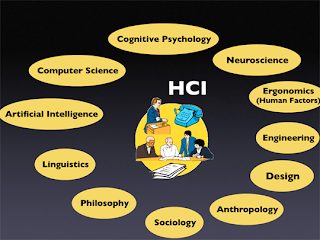
As you can see in the picture above, there are a lot of components that make up the Human Computer Interaction to make our lives easier. As we develop a deeper understanding in each of these areas, technology is only going to get stronger and become more integrated with each area. Just think about technology and how it relates to one area, such as engineering. How might technology improve everyday life in this area? How about linguistics? Will technology allow us to communicate with people who speak other languages across the world quickly and efficiently? We have already seen what technology is doing in areas such as neuroscience and artificial intelligence, as well as plans for future technology in these areas (during class discussions and videos). Imagine what our world will be like once all of these areas are improved and enhanced through advances in technology.

Online Meetings

I was really interested when we started talking about how after 9-11 a lot of people started having online meetings instead of going on airplanes. I recently saw a commercial on t.v. that was a lot like the online meeting that we were shown in class. It's called go to meeting. It also has the feature where you can have everyone seeing the same document and you can also see the people. I think this is such a great idea it saves so much money and time. Not only does it save money and time but it is safer. One survey found that of all of the business people they surveyed more than two thirds of them had online meetings for about a total of four hours each week. I feel like these number will only go up from here on. Online meetings can cut a travel budget by 40%. Not only can you meet online for almost everything but with things like faxing also it is so easy to get documents signed. Also sending out e mails of the documents you will be going over prior to the meeting will make sure everyone is on the same page. Also with all of the larger companies these days there are a lot more people who work from home. it is so much more convenient not to have to pack up and leave for a meeting since they can still just do it from their home office.

NOT A BLOG POST

DOES ANYONE KNOW HOW MANY BLOGS WE SHOULD HAVE DONE SO FAR???

Fiber Op's and Wireless Networks

It wasn't until Monday March 8, 2010 that I found out that the government owned different slots of radio waves. The lecture that day really made me think about some of the things I had been doing on my computer. For example password security! Its amazing how you may know hackers are out they're waiting to prey on people who slip up, but sometimes you tend to think it wont happen to you.

Another thing that was sort of take for granted by me was the benefit of having wireless capability. I remember when I first bought my wireless router. At the time I wasn't tired of the wire connection, but when I found out I could be anywhere in the house and connect I just made the transition.

As I think about it now it is ridiculous to have to have a whole office connected by wires. I just cant imagine how that ever worked!!

Tuesday, March 9, 2010

Human–computer interaction


Last class, the professor talked about human- computer interaction (HIC). HIC helps build a close relationship between people and computers.

And there is a system called user- centered design.It's a modern, widely practiced design philosophy. It is rooted in the idea that users must take center-stage in the design of any computer system. One interesting thing is that scientists should study ethnography of the environment, because the users will be interacting with the system.

When I was doing the team paper, scenario 4, I found it is widely used in fashion industry for designing. A fashion designer need use both software and hardware. Those software and hardware make up an user interface, which to realize his or her compose. For fashion industry, the system is called computer-aided design (CAD). It is used of computer technology for the design of objects. CAD can be used to design curve and figures in two-dimensional ("2D") space; or curves, surfaces and solids in three-dimensional ("3D") objects.

Cell Phone Spy Wear

Another week, another blog! This week's blog is about cell phone spyware. I happen to be on a website and I overcame a video that caught my attention. A woman was being tracked and stalked by an ex boyfriend for two years. (To see the video click the link on the picture).

I don't know about you but when it comes to something like this it is a serious matter. As said on the video, the spy ware is legal to sell but not so sure that its legal to use. I also read in an article that most spy ware is used to hack people phones for their information or even to stalk them.

On another note, some spy ware can be helpful when it comes to children. The spy ware may help the parent/s know where their children are at all times. The problem is when is it crossing the line. That is for you to decide.

Thursday, March 4, 2010

Photography


Over the past few years I have become more and more interested in the world of photography. The tool of the trade is obviously a camera and throughout time it has changed in some very drastic ways. Cameras allow us to capture a moment in time. The style or quality of a camera can show certain times in history. This is shown best when watching the history channel. You can easily see how old a video clip is simple by looking to see if it has color. The camera has shaped the way we look at history.


In 1822 a french man named Nicèphore Nièpce took the first photography of an engraving of the Pope Pius VII. Before this a camera obscura was used to capture images. This camera of sorts would project the image you wanted on to a piece of paper and then the image would be traced by the camera operator. In the 1850's an English inventor came up with the first positive/negative process and this is considered to be the precursor to the modern way of developing film. This allowed for the use of one negative to make multiple positives. The ability to reproduce the same exact picture is a big advantage and allows you to reproduce the picture for more then one person.


In 1861 James Clerk Maxwell, a Scottish man, showed off his color picture at a Royal institution lecture. The picture, seen above, was taken with three different color filters. The red, green, and blue filters were each used to take three pictures of the tartan ribbon. The three images were projected on to a screen and when focused properly a color image appears. In 1877 over a bet the first fast motion pictures were taken. The bet that a horse doesn't fully leave the ground when galloping was settled after Eadweard Muybridge took a picture of a horse while in gallop. The picture showed that before the hind legs hit the front legs had left the ground. The pictures taken would be used in a simple version of stop motion. These advances all lead up to what we see to day in the world of photography.

Tuesday, March 2, 2010

Facebook And It's Interface


By now everyone knows about the famous website facebook. Over the years this website has grown greatly. When I first heard about the website I thought to myself this is something that I don't really need in my life right now. A few friends had it and pressured me into just setting up a page. I noticed the page layout and how it was so easy to communicate with friends around the country/world. To me the page layout is simple but also appealing at the same time. It's nothing too complicated and difficult to manage.

I now have a Facebook page and have had one for about 2 1/2 years now. The creator of the website Mark Zuckerberg says he created Facebook when he was just a college student and wanted a better way to communicate with peers other than using MySpace. I would agree that Facebook is such an easier thing to manage and control then MySpace.

Over the periods of time the new owner of Facebook has made some newer modifications to the website. A lot of the users don't really like the fact that Facebook keeps changing it's way of looking. Personally I feel the same way as well. Even though it doesn't take long to learn how to update your mind on whats happening. It's just the fact that people don't enjoy doing it every six to eight months.