Showing posts with label robotics. Show all posts

Tuesday, February 16, 2010

Robotics


After learning about automation and robotics in class i got to wondering how far man has really come in this field.I surfed the net and found something rather interesting. Theres a company called 'The Braingate Company' and it is a privatly held firm that is focused on the advancement of neural interface systems. On their web site you can clearly see that ,"the goals of the Braingate Co are to create technology that will allow severly disabled individuals to communicate and control everyday functions literally through thought."

Braingate was founded by Jeffrey Stibel. Today the firm is run by a "seasoned team of entrepreneurs." The firms goals are accomplished through strategic partnerships with leading academic institutions, corporations, and varios non profit and government organizations working on research, science, and technology development. The firm's ultimate goal is to improve the quality of life for all humans.

As early as 2004, there were clinical trials performed on humans, that involved an aspirin sized implantable brain-computer interface.The braingate device can provide paralysed or motor impaired patients a mode of communication through the translation of thought into direct computer control.
currently prosthetic limbs are controlled with mechanical switches. However, once perfected, Braingate hopes to provide a more natural control of these devices using brain signals to control movement.

"We hope to provide paralysed individuals with a gateway through which they can access the broad capabilities of computers, control devices in the surrounding environment,and even move their own limbs." - Tim Surgenor, president and CEO of Cyberkinetics

Thursday, February 4, 2010


There was an article today on the website COMPUTERWORLD regarding NASA and GM teaming up to build a robot that can perform dangerous space walk missions. NASA has been using robotics for years to collect samples on Mars, and to aid in the repair and maintenance of the international space station. GM also has used robotic arms and other automation processes in their plants to build automobiles.

This robot, the Robonaut 2, is designed to be able to manipulate small objects and perform more dexterous tasks than the robotics that NASA currently uses. It can also stay out in space with out worrying about running out of air, or having to manipulate objects while wearing bulky protective equipment. Also, the Robonaut 2 would be better suited to making long journeys in space without the negative effects that humans might experience (such as being injured without a hospital nearby, or home sickness).

As for advantages to car manufacturers, because of the dexterity of its "hands" it can perform precision work on small parts. It also would help improve safety in the plants because it would not tire or become distracted. Of course, some of the people who currently work in auto plants are concerned that this is yet another step in replacing more workers with automation and will result in further job losses.

All in all, the use of robots to perform tasks can greatly benefit mankind. Dangerous tasks can be delegated to automation, and costs will be lowered. We are on the cusp of another revolution, and much like the industrial revolution some people will have a difficult time making the transition. However, I feel that much like the industrial revolution the end result will improve the quality of life for many people, and lead the way for future inovation.

Robotics and automation


In discussing robotics and automation during last class, I was compelled to consider possible future scenarios involving their use. The following are 3 possibilities:

1. Military - although robotics are currently in use in the military, due to significant funding and the desire to mitigate human casualties, use of robotics seems very likely to expand. Allowing house entries and street sweeps to be performed by robots, particularly in the midst of insurgent wars (like Iraq and Afghanistan), could have a dramatic impact on casualty rates. Here is an example of future military uses of robotics.

2. Household - home automation continues to develop and become more popular as prices continue to fall. Currently you can automate things like your thermostat, home security, window blinds, lighting, television show recording, etc. In the near future it seems likely that using technology such as RFID, we'll be able to set nearly every electric or electronic parameter in our home to adjust automatically to our very presence either within the home at large or specifically based on what room we are entering or leaving. The obvious benefit beyond simple ease is energy management. Thank god we won't have to endure the tedious task of flipping light switches for too much longer!

3. Entertainment - robotics have been used for entertainment devices for a very long time. I suppose one could even consider amusement park rides as examples of entertaining robotics. But as we saw in class in the robotic violinist video, the future holds even more abstract robotic abilities that will enhance human enjoyment. One such example, the Robonica Roboni-i, provides the user with an amazing amount of programmability. It engages in 7 games, which might not seem like a lot, but the future can be seen with a little imagination.

I personally look forward to the diaspora of robotics across all aspects of our daily lives. In particular, although I didn't mention it above, robotics holds amazing potential in the realm of medical procedures and cybernetic physical aids.

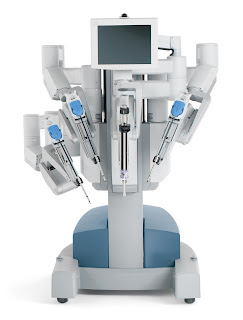
Robotics (da Vinci)


In this week blog my focus will be towards robotics in surgery and its technology. The name of the robot that performs the surgery. However the doctor is in total control. Even though we've talked about it in class, I looked more into to the technology of robotic surgery.


There are different kinds of surgeries that can be performed by the da Vinci. The different kinds of surgeries are bladder cancer, kidney cancer, obesity, prostate cancer, and more. The robot helps the surgeon perform more accurate surgery for the patients (as talked about in class) efficient surgery.


This technology shows how technology in the medical field is improving, not just in the medical field but in general. As we live on, technology is improving on a very fast rate. I believe that it will be a program robot that would perform surgery without the help of a surgeon.